The record
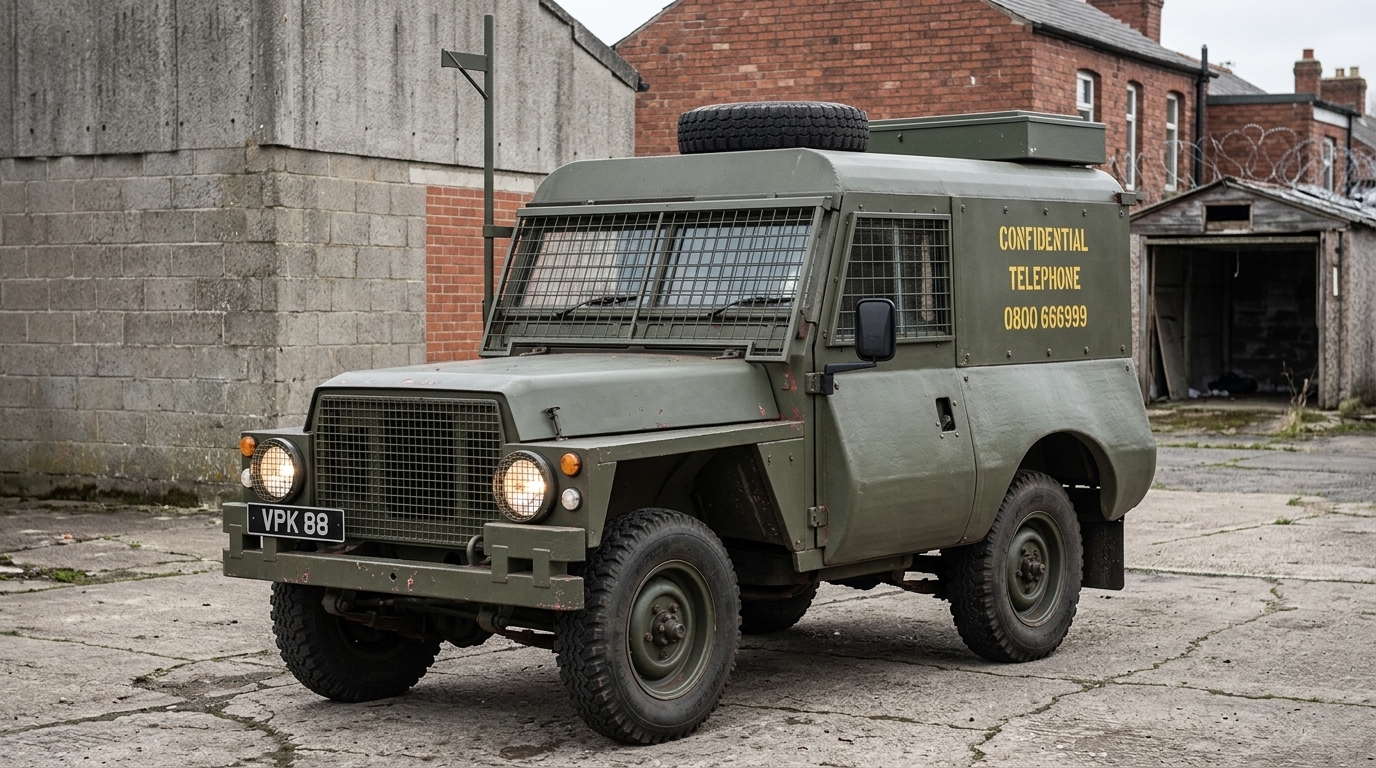
Internal-security operations in Northern Ireland began in 1969, and in the early 1970s the Army fielded the Vehicle Protection Kit — a set of glass-reinforced-plastic panels that turned a soft-skin Land Rover into a protected patrol vehicle without a new chassis. The Ministry approached the Royal Navy, which had GRP experience from submarine conning towers and fittings, for the moulding; the kit could be fitted with standard hand tools in about 32 to 35 man-hours, and taken off again when the vehicle went back to ordinary duties. It gave a full hard top with a rear door and small protected windows, wire-mesh guards hinged over the windscreen and the door glass against thrown missiles, and deep lower side panels curving in beneath the body to shield the wheels and underside. With the extra weight, large cylindrical rubber pads (Aeon springs) replaced the bump stops between axle and chassis.
A later HV kit — High Velocity, proof against high-velocity rounds — took the unladen weight to over 2,500 kg and served as the interim protected Land Rover until the armoured 110 Patrol Vehicle arrived in 1986. In the late 1980s it was common for units to stencil the body sides, in yellow or red, with the Confidential Telephone number 0800 666999, the RUC's anonymous information line — done by the units themselves, and not always very neatly.
The registry's model is the Lightweight in kit form as a surviving example shows it: the standard Series III Lightweight front with its headlamps in the wings and the shared bumperettes, a flat-sided GRP top with the Series hard-top crown, mesh screens over the glass, the rounded skirts, the spare lying on the cab roof, a wire catcher — the sharpened steel bar up the windscreen pillar that lifts and cuts wires strung across a road — and the three-line yellow stencil on the rear side panel. The registration is not legible and is left as a placeholder.
