The expedition
Mike and Mal Leyland, born in Hitchin and brought to Newcastle, New South Wales, as boys in 1950, grew up on Armand and Michaela Denis's documentaries and a 16 mm camera their father bought for the 1956 Olympics. They filmed their first outback trips in an old Land Rover — a mechanic friend had talked them out of their father's Morris Minor for the drive to Ayers Rock — and in 1963 released Down the Darling, the first descent of the whole Darling River, in an aluminium dinghy. Mike was a news cameraman at NBN Television and Mal a cadet on the Newcastle Sun when they planned something bigger: a crossing of Australia from its westernmost point to its easternmost, straight through the arid centre along the 26th parallel, something no car had done. It took, by Mal's count, 36 months of dreaming, planning and trials and eighteen months of preparation.
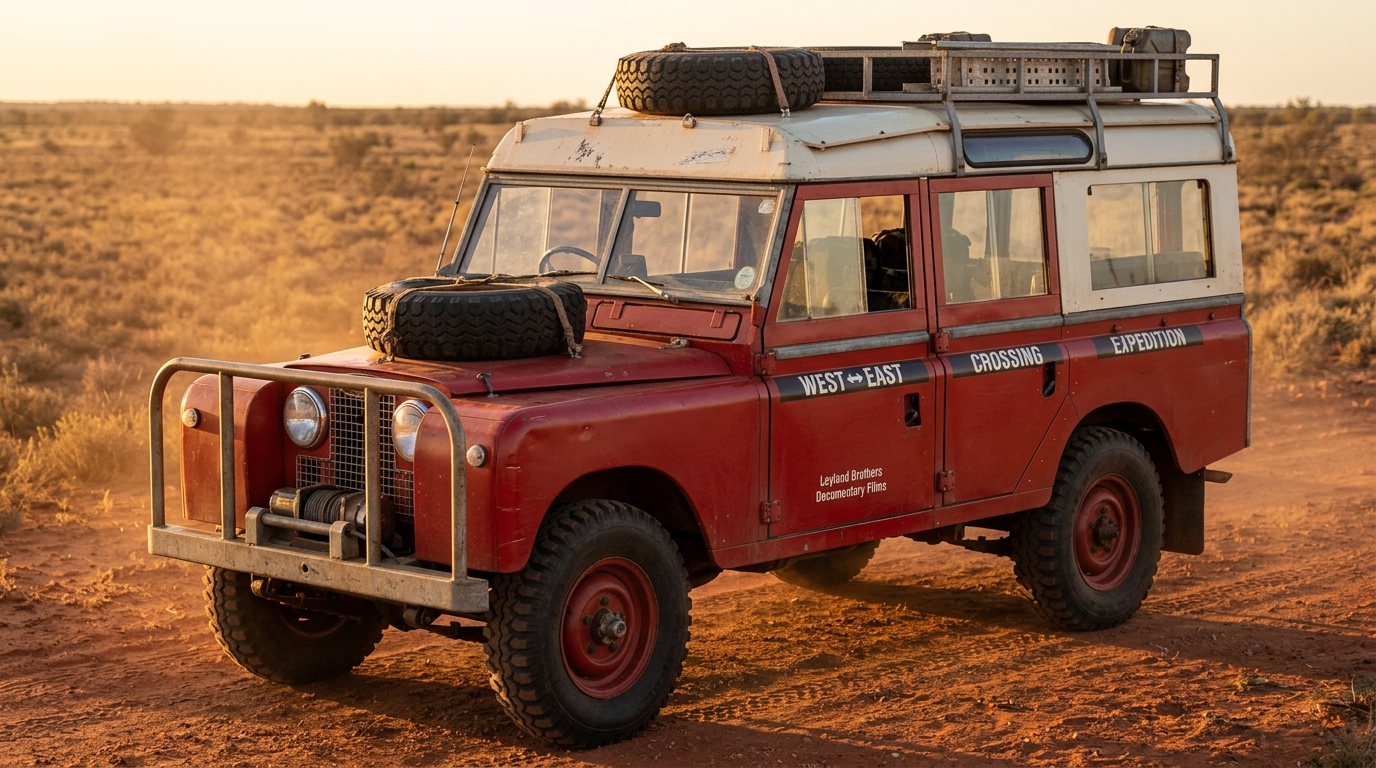
The vehicles were built in Newcastle by the mechanic Ted Hayes, who came on the trip. The main car was a 1956 Series I 107-inch five-door station wagon whose chassis and body Hayes lengthened to take a three-litre six-cylinder Rover car engine, with long-range tanks, an extra fuel pump, a bonnet-mounted oil cooler and reservoir, extra rear springs and a bull-bar, plus a capstan winch, HF radio and safari roof, on Michelin 7.50×16 sand tyres; Mike, a trained sign-writer, hand-painted its lettering. The second was a 1963 88-inch petrol hard top on 9.00×16 aero sand tyres with army-style guards, a front jerrycan bar and a tailgate tool box. Both were red, without roof racks, and towed a heavy, hand-built four-wheel trailer made of Land Rover parts; a 1966 Bridgestone 90 Mountaineer motorcycle went along for scouting. Australian Museum naturalist Keith Davey asked them to collect specimens on the way.
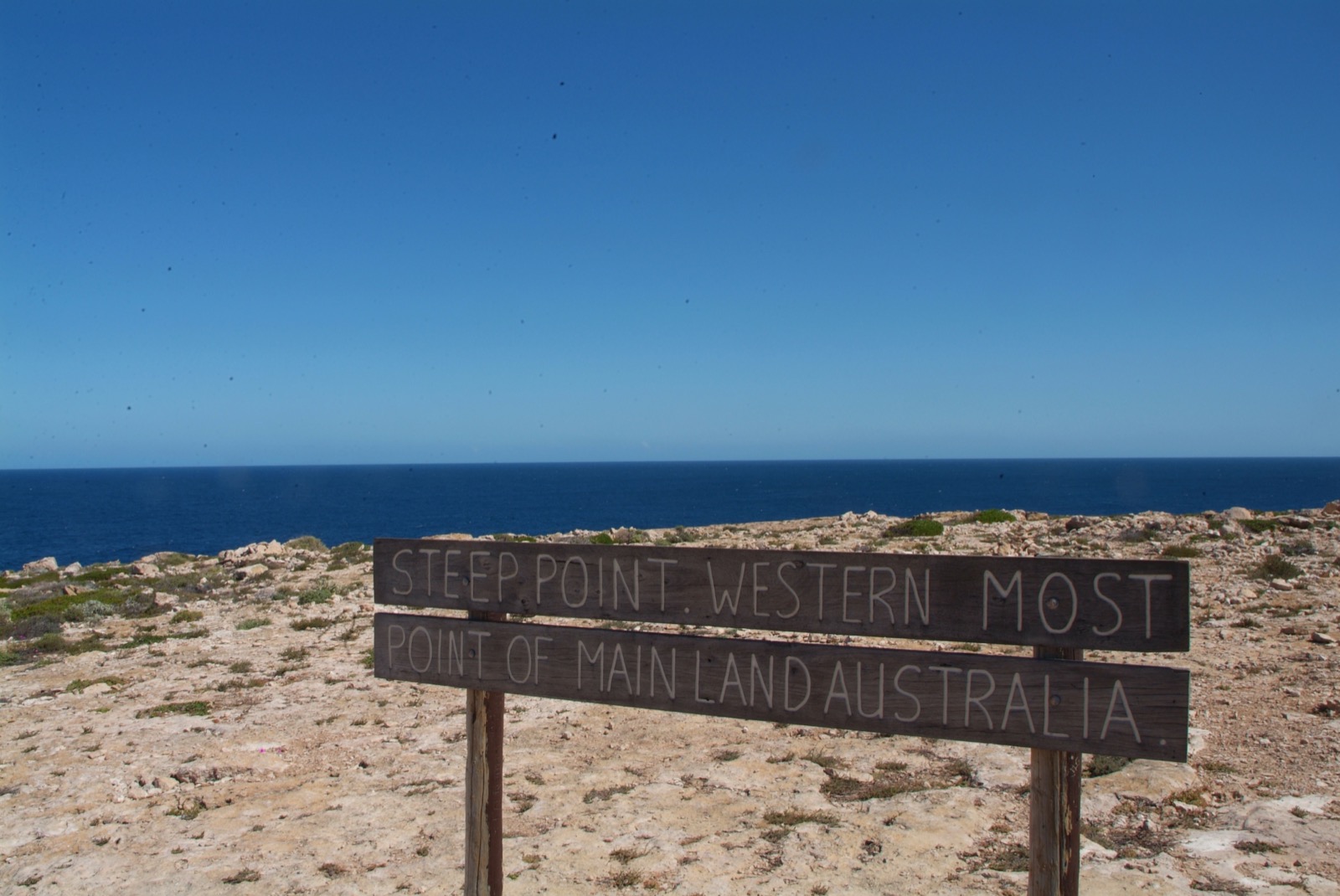
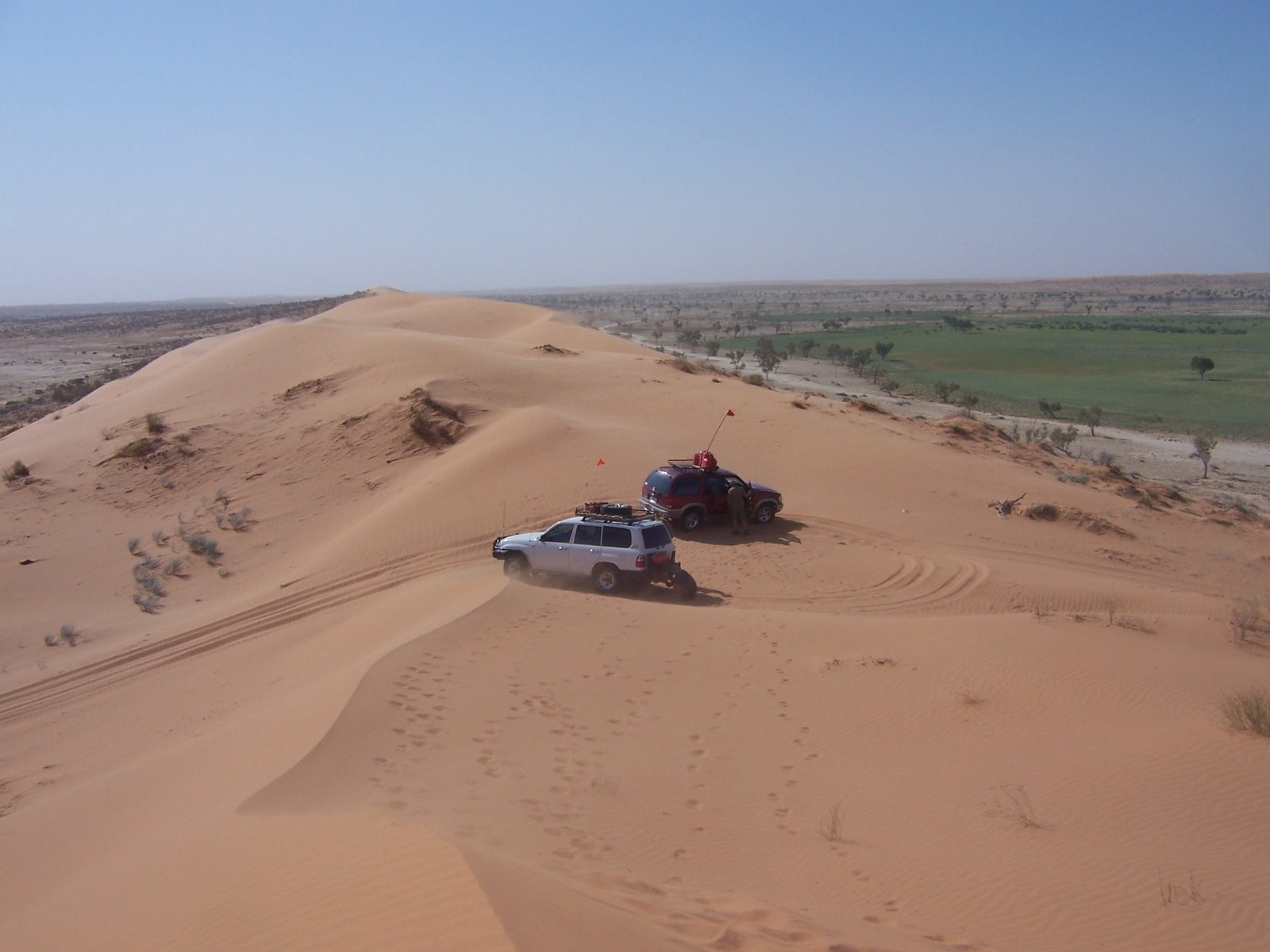
They left Steep Point, near Shark Bay on the Indian Ocean, on 3 May 1966, with a sample of the ocean aboard, and went inland through Woodleigh sheep station to Meekatharra and Wiluna, then east along Len Beadell's Gunbarrel Highway to Carnegie and across the Gibson Desert to Giles. At Ayers Rock it rained, and they became the first film-makers to capture the Rock in the wet. From Finke and Andado they entered the Simpson Desert, which took 22 days and 1,105 sand ridges; the older car kept breaking differentials — 'we were sick of broken diffs', Mal wrote — and the number of breakdowns, mostly on the station wagon, was 'both surprising and annoying', survivable only because Hayes understood the cars and there were two of them. From Birdsville they ran east through Windorah, Cunnamulla, Goondiwindi and 500 miles of Queensland mud to Lismore and reached Cape Byron on the Pacific on 20 August 1966: 111 days of travel and 4,248 miles, at 17 miles to the gallon on the best roads and three in the desert. They had collected some 2,000 insect and 300 reptile specimens for the museum.
Wheels Across a Wilderness, shot by Mike, was released in 1966 and the brothers took it round small cinemas and halls themselves, cutting it in a basement editing suite and netting up to $15,000 from a fortnight's showings; the book Where Dead Men Lie followed. The film's success led to Open Boat to Adventure in 1969, The Wet in 1972, the television series Off the Beaten Track in 1970 and, from 1976, Ask the Leyland Brothers, watched by 2.5 million people an episode. After the crossing the station wagon toured the country with the film and was put into storage in 1969; Mike Leyland gave it to the History Trust of South Australia in 2003 (accession HT 2003.0309), and it is displayed at the National Motor Museum, Birdwood. Both brothers were appointed MBE; Mike died in 2009. The Land Rover Owners Club of Victoria retraced the crossing for its fortieth anniversary in 2006.