By the end of the 1950s the long-wheelbase Land Rover had run out of load bed. A 109-inch pick-up carried about three-quarters of a ton and its bonnet took up a third of the chassis. Rover's answer, shown at the Commercial Motor Show in September 1962, was to leave the 109-inch chassis and running gear alone and bolt a new sub-frame on top of it, with the cab sitting over the engine and a flat 30 cwt load platform behind. The Commercial Motor's show report said the new truck used the same wheelbase and most of the same mechanical parts as the normal-control 109, but gave a much larger cargo area and a front-to-rear axle loading that was now virtually 50–50; for a European four-wheel-drive rated at 30 cwt on the road it was, the magazine said, in a class by itself.
The Forward Control stayed in the catalogue for ten years in two forms — the Series IIA of 1962–66, and the redesigned Series IIB of 1966–72 with wider axles, a 110-inch wheelbase and the 2.6-litre six — and about 5,500 were built. Most went to work: county and works fire brigades, the Post Office Telephones fleet, quarries, the armed forces and export customers who needed a truck where there were no roads. A third attempt, the Llama of 1985–88, was built on the coil-sprung One Ten chassis for a Ministry of Defence contract to replace the 101 Forward Control, and was cancelled after eleven prototypes and one production vehicle. The marque is small, and the registry holds seven records of it: the two factory trucks, two Post Office conversions, two fire appliances and the Llama.
Series IIA Forward Control (1962–1966)
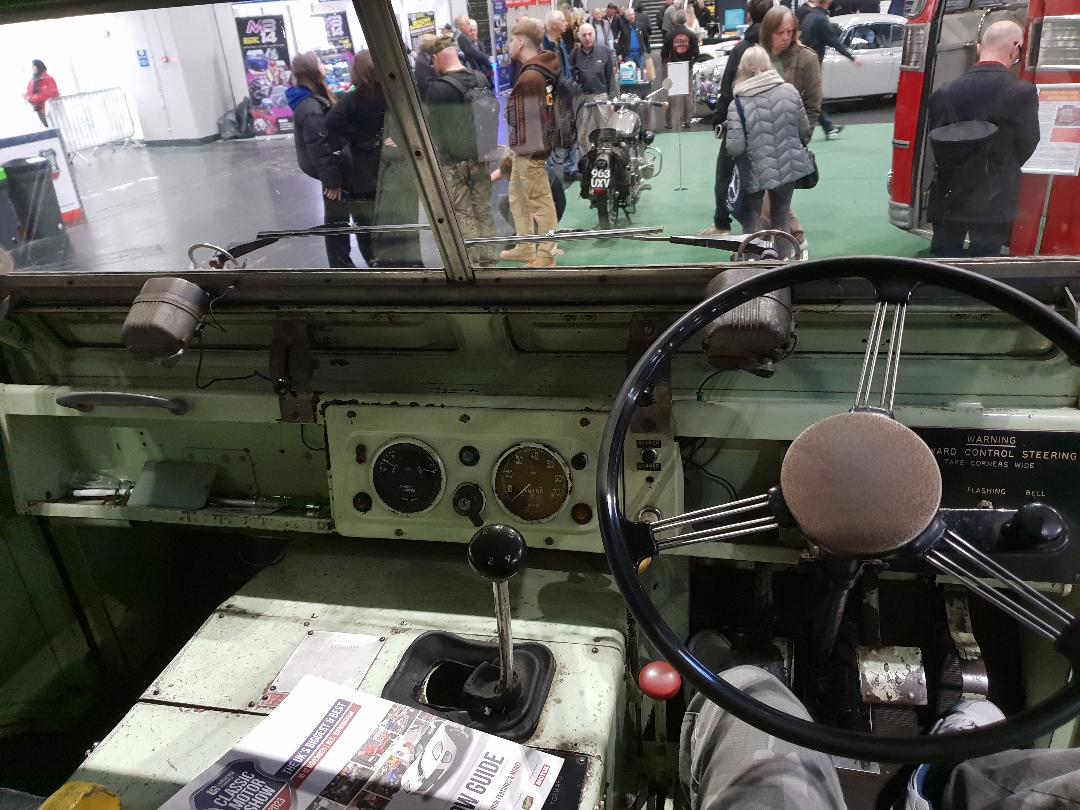
1 VEHICLE IN THIS CHAPTERThe Series IIA Forward Control was engineered for cheapness as much as capacity. Winwaed's model history describes a new rear sub-frame attached to the standard 109-inch chassis to give a flat load space, with front and rear sub-frames chosen 'for economic reasons'; the Land Rover Series 2 Club puts the shared content at 75 per cent of the ordinary 109's chassis parts. The cab used Series IIA panels, the radiator moved forward with the fan driven off the propeller shaft, and the body was a drop-side tray on longitudinal girders. It sat on 9.00 × 16 tyres on deep-dish rims to spread the weight. The only body offered by the factory was that pick-up, open or closed cab, and the only seats were the two in the cab.
At launch the engine was the 2.25-litre four from the Series IIA, 77 bhp gross, which was not enough for a truck that weighed two tons empty and was rated to carry another ton and a half. The 2.6-litre six-cylinder engine, adapted from the Rover P4 and P5 cars, went in from the start for export and reached home buyers later; the Series II FAQ counts 2,091 four-cylinder petrol IIAs, 1,097 sixes and just 5 diesels. Handling was the other complaint. The cab sat high on standard-width axles, the steering was 'vague' and the braking 'interesting', in the Allisons club history's words, and the Series 2 Club sums the IIA up as 'under powered and unstable due to the combination of vehicle height and standard width axles'. Stronger ENV differentials were fitted from February 1965, though on six-cylinder trucks the ENV front unit fouled the engine and a Rover front diff stayed. The registry's 1963 IIA carries the model's signature: headlamps set high in the front panel and curved rear mudguards, the quickest way to tell it from the IIB that followed.

_-_29151237781.jpg)
_(53339842260).jpg)
Registry records · chapter 1
Series IIB Forward Control (1966–1972)
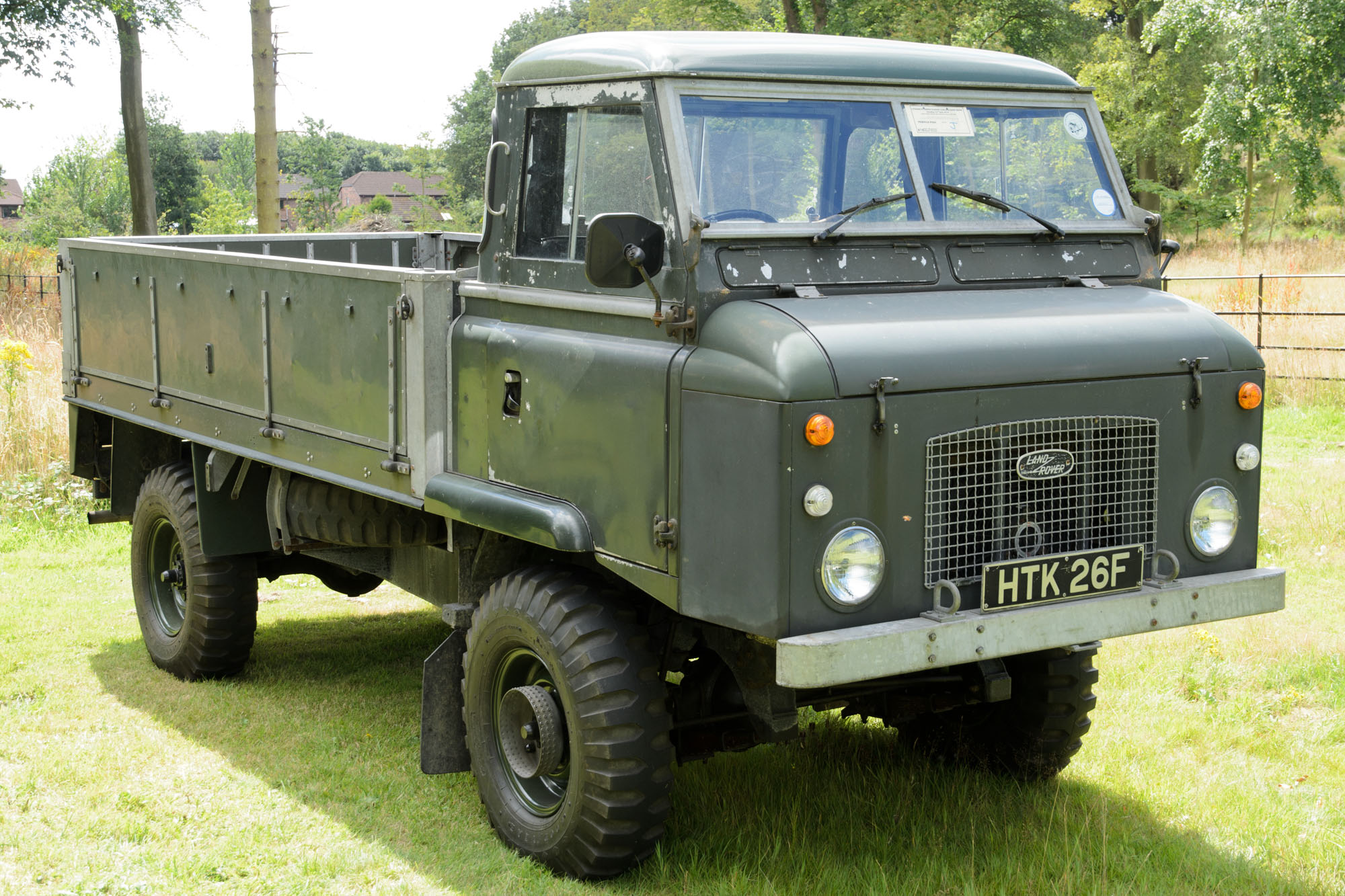
3 VEHICLES IN THIS CHAPTERThe Series IIB Forward Control of September 1966 answered the two complaints at once. The track went out by four inches to 57½ in on heavy-duty ENV axles with a front anti-roll bar, the rear springs moved on top of the axle, and the axles were shifted three-quarters of an inch forward to clear the six-cylinder engine, which is why the wheelbase became 109.75 in and the truck was sold as a 110. The headlamps came down into the bumper line and the side lights went up; the gear lever and handbrake were relocated. The 2.25 diesel was offered for the first time, and it sold: 524 diesels against 527 four-cylinder petrols and 1,254 sixes, according to the Series II FAQ's 2,305 total. The IIB existed only as a forward-control — there was no normal-control Series IIB — and its wide axles and gearbox were carried over into the 1-ton 109 of the Series III range.
The Post Office Telephones fleet is the best-documented civilian user. Britishtelephones.com's works record lists fleet numbers 203038 to 203052, fifteen '30cwt Forward Control (Petrol)' chassis registered WLA 984G to WLA 998G in 1968 and fitted with the Simon Hoist M28 elevating platform for overhead line work; the registry's WLA 990G is the one photographed at the Regional Training Centre at Bletchley Park in November 1971. The same fleet's research arm cut a IIB chassis cab down into an articulated tractor unit, EMF 739J, pulling a single-axle step-frame box trailer to reach test sites a road-going artic could not. Both came from the maker the registry lists as Post Office Telecommunications.
_-_29364327694.jpg)
Registry records · chapter 2
Fire, military and late production (1968–1979)
3 VEHICLES IN THIS CHAPTERThe forward-control layout suited a light fire appliance: a crew compartment behind the cab, lockers down the sides and a pump at the back on a chassis that could reach a moorland or range fire. HCB-Angus of Totton bodied IIBs for brigades and for the services; the registry's 1973 Army Fire Service appliance has the 2.6-litre six, a two-speed transfer box with selectable four-wheel drive, a power take-off for a rear Godiva pump rated at 350 gallons a minute at 10 bar, and worked the Salisbury Plain camps before a second career on the Channel Tunnel construction site. The fire history follows the type through the county brigades.
Military customers took the IIB too. In South Africa, the Series II FAQ records, IIBs were built under a special military contract until 1976 — four years after Solihull stopped — with the full-synchromesh 'one tonne' gearbox. Production at home ended in 1972; Wikipedia gives 1974 and attributes the end to Land Rover rationalising its range, but the FAQ, Winwaed and the Series 2 Club all close the books in 1972. That left the fire trade without a compact cab-over four-wheel-drive, and Bates of Evesham filled the gap by re-engineering the 1-ton 109 chassis, itself built on IIB axles, into a cab-over appliance with a four-seat crew cab: the L4P, of which 52 were built and 44 went to the Northern Ireland Fire Brigade. Spain went its own way. Santana's 1300 forward control of 1967–78 and its 2000 successor were Linares designs on the licensed 109 base rather than British trucks, and the registry treats them as Santana models; James Taylor's 2025 Amberley history covers the 109, 110, 101, Santana 1300 and 2000, and the 112/120 and Llama prototypes as one family.


Registry records · chapter 3
The Llama (1985–1988)
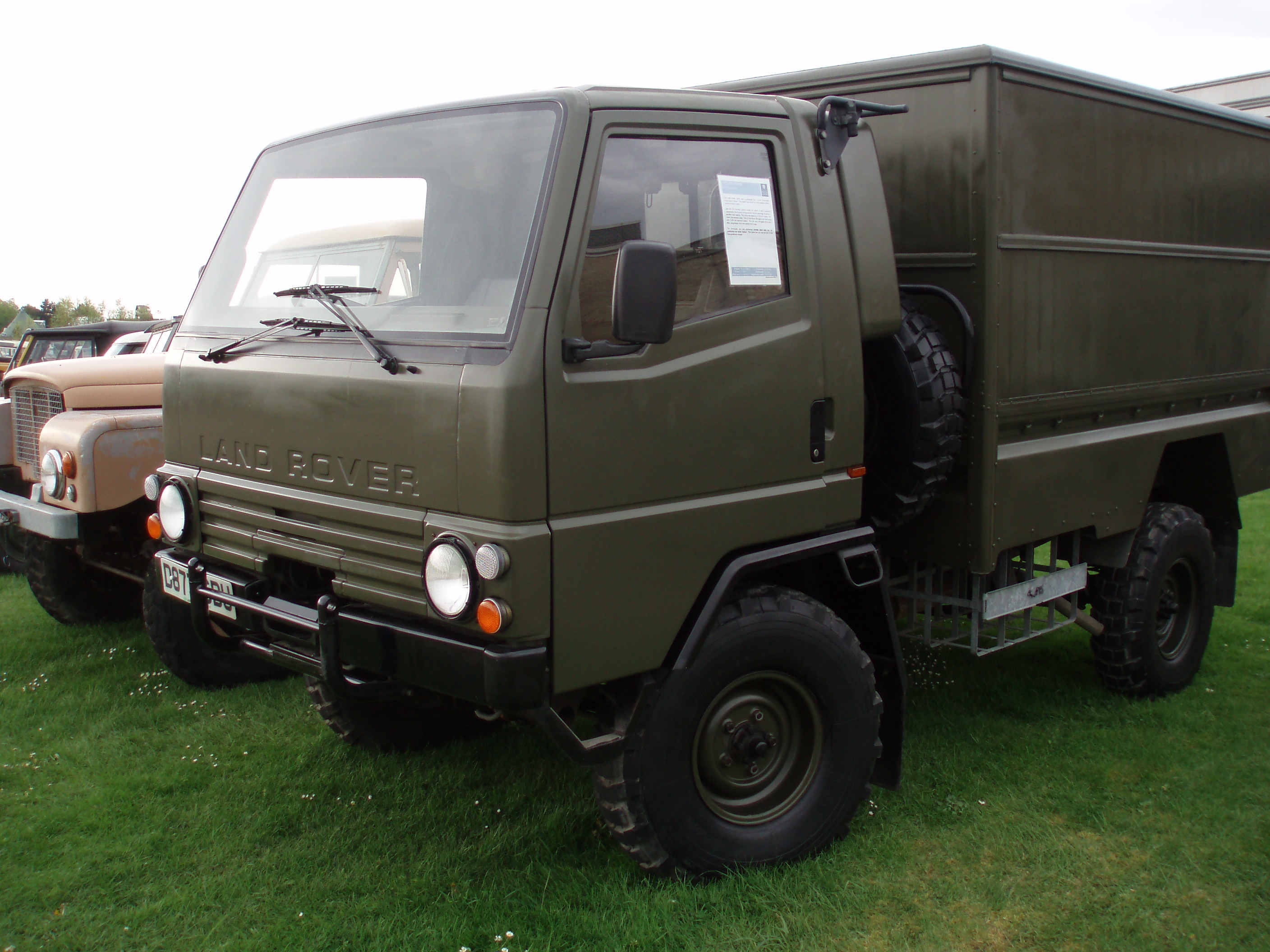
1 VEHICLE IN THIS CHAPTERLand Rover's last forward control was a bid for a military contract. In 1985 the Ministry of Defence wanted a replacement for its 101 Forward Control gun tractors, of which Wikipedia says it had bought more than 1,700, and Solihull began the Llama on a One Ten chassis in thicker steel, with coil springs, twin rear springs, custom axles twelve inches wider than standard, the LT85 five-speed gearbox and LT230 transfer box, and the 3.5-litre V8 on Zenith-Stromberg carburettors tuned to 110 bhp. One prototype carried the 85 bhp 2.5 turbodiesel instead. The cab was glass-fibre on a steel space-frame, hinged at the front and tilting forward for access, and trimmed with parts from the Metro and Montego; payload was 1.75 tons. An early mock-up on a 110-inch chassis was destroyed, then, in the Dunsfold Collection's account, ten pre-production vehicles were built and one to full production standard — eleven prototypes and a single production-line Llama in Wikipedia's count, all in 1986–87.
Trials at Bagshot went badly. Laden, the tall coil-sprung truck was unstable over rough ground and slow, the petrol V8 sat wrongly with a ministry that had just standardised on diesel, and the turbodiesel could not move 2.5 tons; the MoD chose the Reynolds Boughton RB44 on the Dodge 50 chassis instead, and without a military order Land Rover would not launch the Llama on the civilian market. It was cancelled early in 1988. The RB44 then proved so unreliable that the 101s stayed in service until the late 1990s. What survives: the registry's Llama is the sole production-line box van at the British Motor Museum, Gaydon; Dunsfold holds prototypes 1, 2, 4, 5 and 10, among them number one, C412 SNP, and the only soft-top, Q276 DPG; and a 'new' Llama was assembled in 1998 on the bare chassis of what would have been production vehicle number two. One trace stayed in the production Defender: the cab-lock warning light designed for the Llama's tilting cab remained on the dashboard until 1998.

Registry records · chapter 4
In service
Where the registry's Forward Control records worked; each opens the themed history.Manufacturers
Sources
- Land Rover series — Forward Control — Wikipedia (IIA 1962–66 and IIB dates, engines, ENV axles, 9.00×16 tyres, 'less than 2,500' IIAs, IIB components on the 1-ton 109)
- Land Rover Llama — Wikipedia (Llama 1985–88, 11 prototypes plus one production vehicle, engines, chassis, cancellation, RB44, survivors)
- The Land-Rover Series II 109" Forward Control FAQ — retro.co.za (September 1962 and September 1966 introductions, 1972 end, dimensions, engine outputs, production table by engine, ENV diffs from February 1965, South African military IIBs to 1976, chassis prefixes)
- The Land Rover History: Forward Control IIA and IIB — Winwaed (Sub-frame construction, 30/25 cwt ratings, engines from the P4/P5, IIB changes, pick-up as the only body)
- A Brief History of the Land Rover Series 2, 2A and 2B FC — Silodrome (Jon Branch) (Production figures by engine for IIA and IIB, 110-inch wheelbase, relocated controls)
- Model History — Land Rover Series 2 Club (75 per cent shared 109 chassis content, IIA instability, IIB wider axles and low headlamps)
- Forward Control Land-Rovers — Allisons.org (Bolted sub-frame, propshaft-driven fan, drop-side tray, PTO winch, steering and braking criticism)
- Land Rover Series II FC (1962–74) — Truck Encyclopedia (5,498 combined total, dimensions and kerb weights)
- Post Office Telephones vehicles: Simon Hoist M28 Platform Elevating — britishtelephones.com (Fleet numbers 203038–203052, WLA 984G–998G, 1968, Bletchley Park training centre)
- Land Rover IIB Forward Control Fire Engine (ex Army Fire Service) — defender-landrover.co.uk (1973 HCB-Angus appliance, 2.6 six, Godiva 350 gpm pump, Salisbury and Channel Tunnel service)
- 1985 Pre-production Land Rover Llama number one — The Dunsfold Collection (C412 SNP, ten pre-production plus one production-standard, Bagshot trials, Reynolds Boughton chosen)
- 1985 Pre-production Land Rover Llama number four — The Dunsfold Collection (Q276 DPG, the surviving soft-top of eleven Llamas)
- The Story of the Land Rover Llama — autoevolution (Tilting glass-fibre cab, Metro/Montego parts, RB44 unreliability extending 101 service, cab-lock warning light to 1998)
- Land Rover Forward Controls (James Taylor, 2025) — Amberley Publishing (Scope of the family: 109, 110, 101, Santana 1300 and 2000, 112/120 and Llama prototypes)
- Santana — LR-MAD (Santana 1300 (1967–78) and 2000 as Linares designs rather than licensed British forward controls)
- Newcomers wherever you look (Commercial Motor Show report, 21 September 1962) — The Commercial Motor Archive (Launch report: same wheelbase and mechanicals as the 109, 30/25 cwt, 50–50 axle loading, 'in a class by itself' — read via search excerpt; the archive page itself would not load)
Forward Control records in the registry
11 records, oldest first.Series IIA Forward Control1962–66 · United Kingdom GPO Yeading TV Outside Broadcast1966–71 · United KingdomSeries IIB Forward Control1966–72 · United KingdomGPO Cabling Test Van1968 · United KingdomGPO Platform Elevating Simon M281968 · United KingdomGPO Forward Control Tractor1970–71 · United KingdomVaduz Marte Pikettfahrzeug1970 · United KingdomGPO Spencer Elevating Platform1971 · United KingdomBates FC L4P1972–79 · United KingdomArmy Fire Service HCB-Angus FC1973 · United KingdomLand Rover Llama1985–88 · United Kingdom