The 101 Forward Control was the only Land Rover designed from a blank sheet for the Army. In 1966 the British Army began replacing its 105 mm pack howitzers with the new 105 mm Light Gun, and it needed an air-portable tractor that could tow the gun — 4,088 lb as built — with a ton of ammunition and a six-man detachment in the back. Land Rover's engineering department and the Military Vehicle Engineering Establishment formed a joint design committee, Norman Busby was appointed project engineer in the middle of 1966, and the first prototype, a square-nosed truck with a three-litre straight-six, went to MVEE in the summer of 1967. By December 1968 the prototype had the ex-Buick 3.5-litre V8; hot-weather trials in California followed, the vehicle was unveiled at the 1972 Commercial Motor Show, and the Army took it into service in 1975.
The layout was dictated by the aircraft. Sitting the cab over the front axle and the V8 beneath and behind the seats did away with the bonnet, so that a 101-inch wheelbase gave a full-length load bed and a nearly cuboid body that wasted no space in a transport hold; the panels came off for air freighting. It was officially the Land Rover One Tonne, from its payload, and 101 from its wheelbase. About 2,660 were built, almost all for the Ministry of Defence, as soft-top General Service trucks, 24-volt radio vehicles, Marshall-bodied ambulances, Vampire electronic-warfare wagons and Rapier missile tractors, and four of the first production examples made the first west-to-east crossing of the Sahara in 1975. The registry holds the cargo truck, the ambulance and the Sahara expedition car; the military history puts the type among its stablemates.
Requirement and prototypes (1966–1972)
1 VEHICLE IN THIS CHAPTERThe requirement came from the gun. The Ex-Military Land Rover Association's account traces the project to 1966, when the Army began the change from the 105 mm pack howitzer to the lighter 105 mm Light Gun, finally accepted in 1973, and wanted a compact tractor to go with it: it had to tow the gun and carry its crew, ammunition and equipment, and fit an aircraft. Land Rover and MVEE set up a design committee, Norman Busby (1931–2005) took the project in mid-1966, and the first prototype was built over the winter of 1966–67 and delivered to MVEE that summer. The Dunsfold Collection describes those first designs as square-nosed and 'not particularly attractive', with a six-cylinder petrol engine — a three-litre straight-six giving 110 bhp at 4,500 rpm — before the V8 arrived during trials; the EMLRA dates the ex-Buick 3.5 V8 to December 1968, and MVEE approval followed hot-weather testing in California.
What emerged was mechanically a Range Rover under a truck body. The V8 drove through the LT95 four-speed gearbox and two-speed transfer box with permanent four-wheel drive and a vacuum-engaged centre-differential lock; the rear axle was a lighter Salisbury unit in place of the heavy ENV of the Series IIB, the brakes came from the 1-ton 109, and new half-elliptic leaf springs carried the one-tonne payload. Winwaed's model history puts the towing requirement at loads up to 4,000 lb. The clever part was the trailer: a Rubery Owen powered-axle trailer, driven from a power take-off at the back of the truck, was meant to sit between the tractor and the gun and turn the outfit into a six-wheel-drive train. The Dunsfold Collection's pre-production chassis number one, 96400001A, a left-hand-drive truck registered BXC 676K in 1972, still shows the round reflectors and locker catches that never reached production, and records that the powered trailer 'never progressed beyond user trials'.


Registry records · chapter 1
Pre-production vehicles and the Sahara expedition (1972–1975)
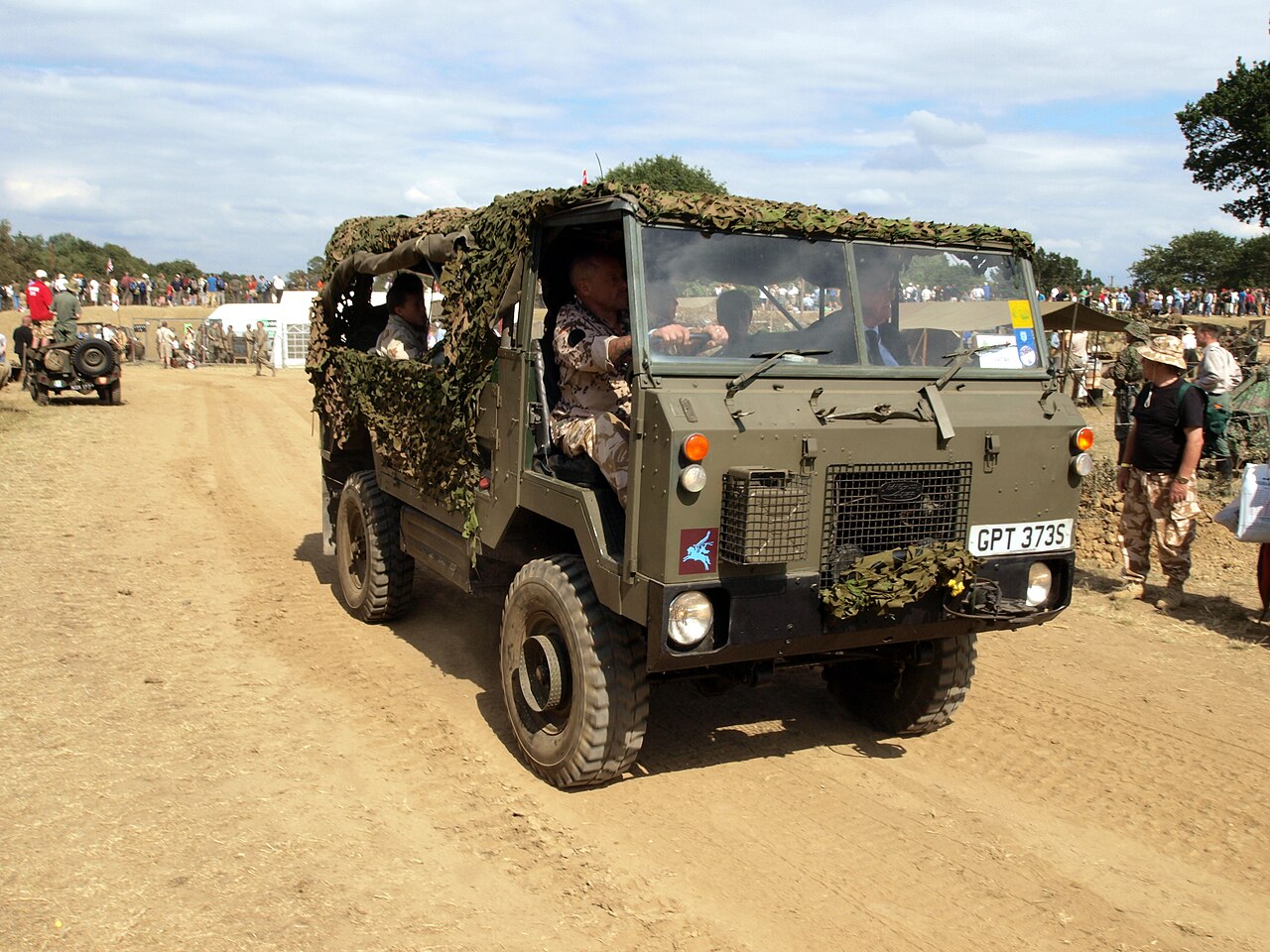
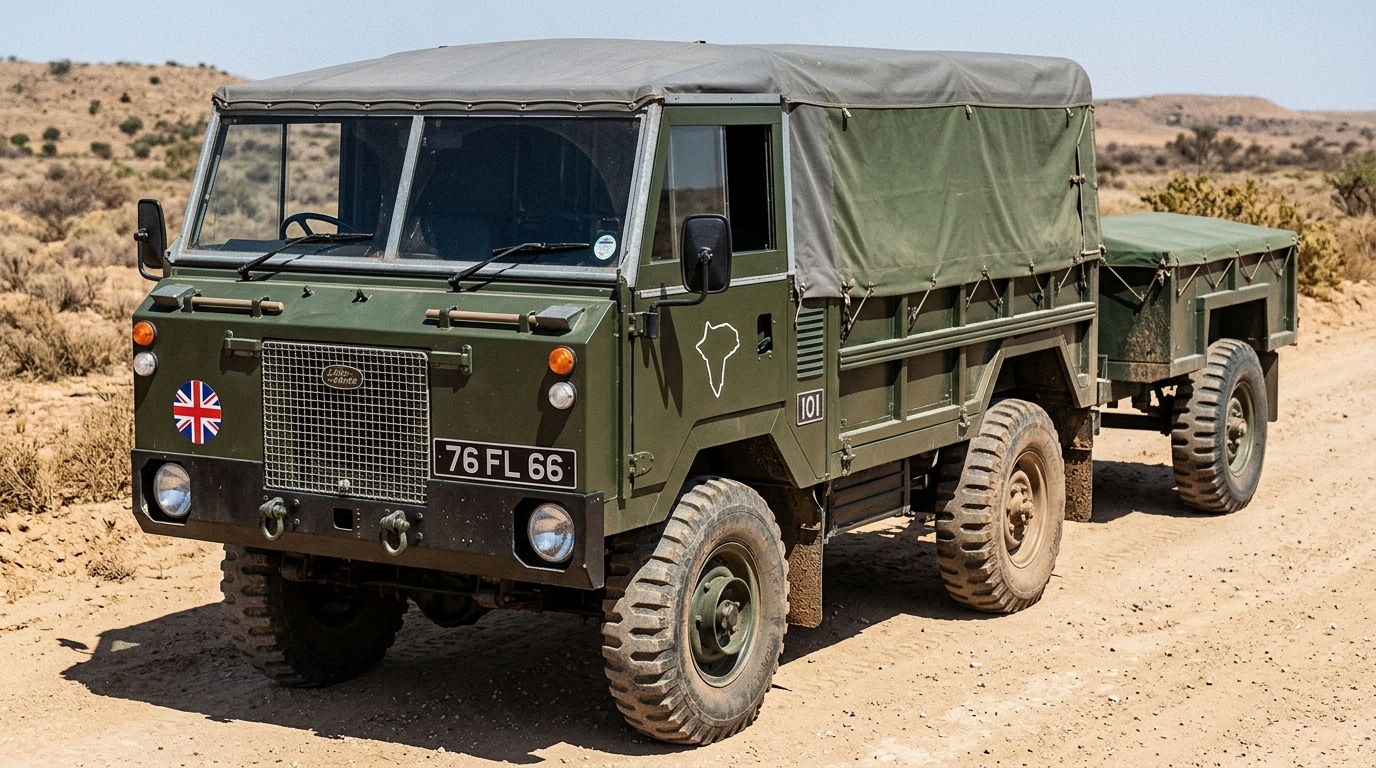
2 VEHICLES IN THIS CHAPTERThe 101 was shown at the Commercial Motor Show in 1972, and the EMLRA's table records a trickle of vehicles in the first three years — 27 in 1972, 10 in 1973 and 8 in 1974 — before the line at Lode Lane got going with 838 in 1975. The eight of 1974 include the four chassis that made the marque's name. Chassis 95600021A to 95600024A were delivered to RAF Uxbridge in November 1974 for the Joint Services West–East Sahara Expedition, led by Squadron Leader Tom Sheppard MBE with a services team and the backing of the Royal Geographical Society. Three of the four carried the power take-off drive for Rubery Owen powered trailers, so that a fuel payload rode between the axles of a six-wheel-drive outfit.
Algeria refused entry, which pushed the route south through the Sahel. The convoy left the Atlantic coast of Mauritania on 25 January 1975, crossed the trackless Mauritania–Mali Empty Quarter, went through Niger, Nigeria, Chad and Sudan to the Nile, shipped across the Red Sea from Port Sudan to Safaga and reached Cairo on 3 May: 12,054 km, 81 days coast to coast, with a gravity survey the whole way and navigation by sun compass and astro-fixes reduced on an HP-65 programmable calculator. Sheppard's report appeared in the Geographical Journal in July 1976 and Anglia Television filmed the crossing. Two of the four cars survive in known hands: the last, 95600024A, 'Tail End Charlie', restored in expedition livery with its powered trailer and given to the Dunsfold Collection in 2016 by its long-term owner David Olliver, and 60 FL 38, the one without a trailer, which is the registry's expedition 101. Sheppard was reunited with one of them, its sun compass still mounted, in 2012.

Registry records · chapter 2
Production variants: ambulance, radio and Rapier (1975–1978)
2 VEHICLES IN THIS CHAPTERProduction ran from 1975 to 1978 in six streams, in the EMLRA's breakdown: 1,332 right-hand-drive home trucks, 28 right-hand-drive export, 583 left-hand-drive export, 170 right-hand-drive 24-volt, 465 left-hand-drive 24-volt and 92 left-hand-drive 24-volt export. The 12-volt General Service truck with its canvas tilt over a flat-sided cargo body — the registry's cargo 101 — was the basic gun tractor; the 24-volt trucks were Fitted For Radio. About a fifth of the fleet, by the guide2landrover figure, had a propshaft-driven Nokken capstan winch mounted amidships on the chassis.
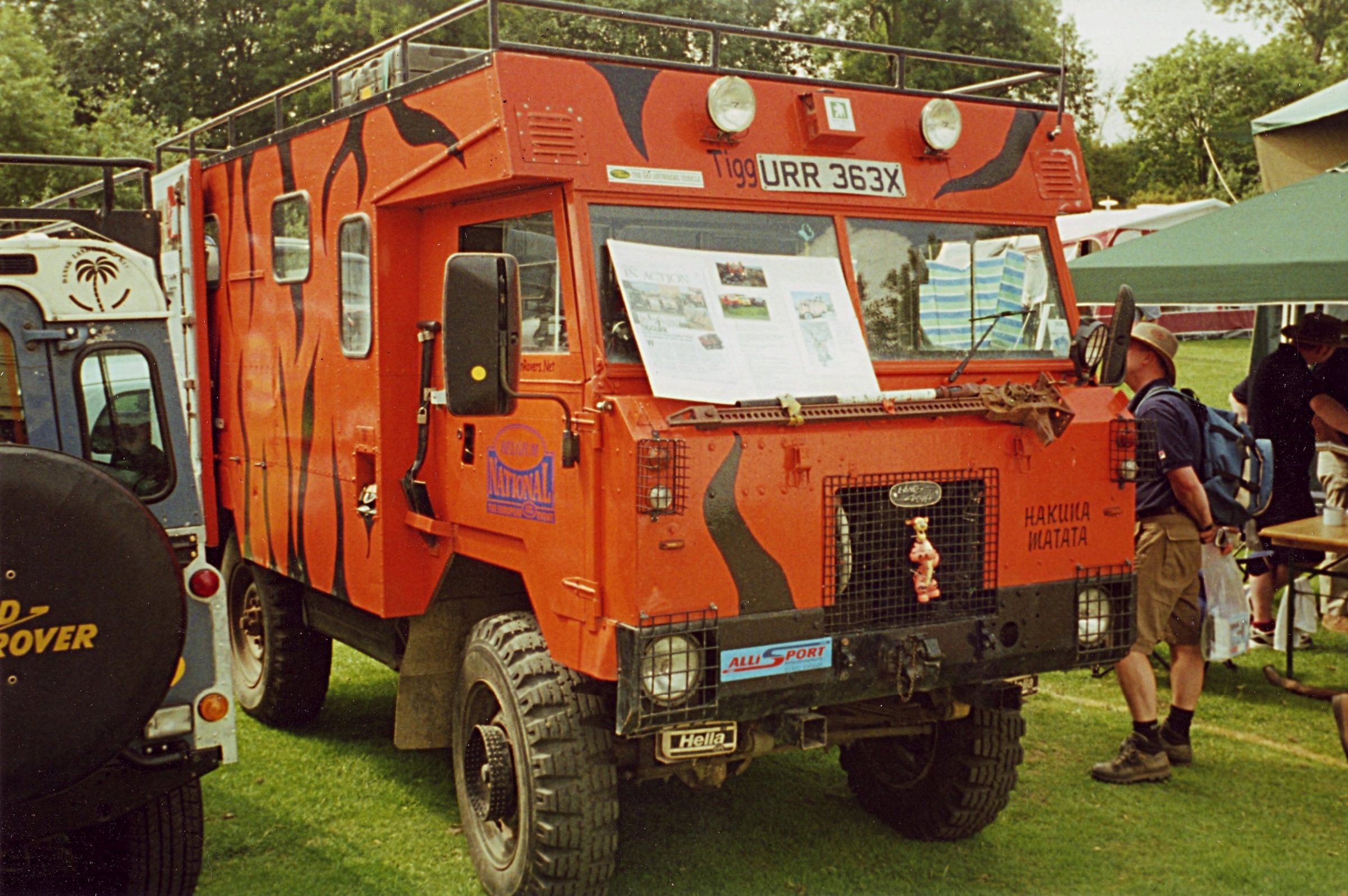
The hard bodies came from outside. Marshall of Cambridge built the ambulance body, and the registry's 101 ambulance follows it; the guide2landrover figure is 300–450 ambulances, and the Dunsfold Collection's prototype, 959000033A, registered RGN 239P in 1975, has the air-conditioning grille above the windscreen, went to a Gurkha regiment and came back from the first Gulf War in desert paint. The same guide counts about 125 hard-top radio trucks and about 20 Vampire electronic-warfare wagons, of which fewer than half survive. The RAF Regiment used the 101 in pairs for Rapier: a 24-volt Firing Unit Tractor towing the launcher with four missiles, and a 12-volt Tracking Radar Tractor towing the Blindfire radar, both winch-fitted. Australia bought the type for the same role — fifty, in Wikipedia's account; 58 supplied through British Aerospace between 1976 and 1978 in the Australian REMLR register's — and those trucks, later disposed of, are the reason the 101 turns up at Australian military shows today.

Registry records · chapter 3
Service, withdrawal and preservation (1978–1999)
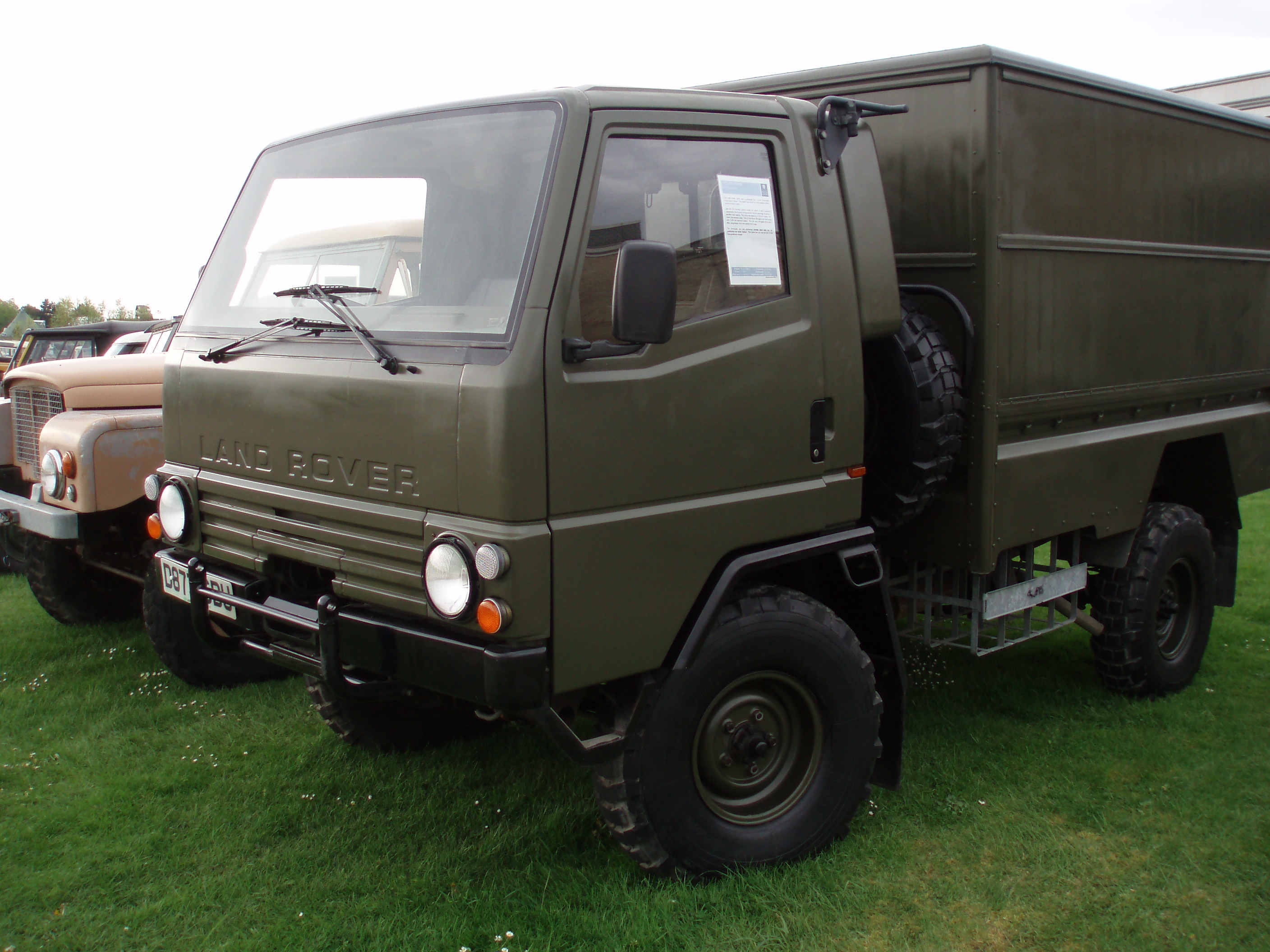
3 VEHICLES IN THIS CHAPTERThe 101 went to war twice. Parachute and Commando units took it to the Falklands in 1982, and in 1990–91 it towed Rapier in Saudi Arabia during the Gulf War; Royal Marines used it in northern Iraq afterwards and a few served in Croatia and Bosnia in the early 1990s. It should have gone sooner. In 1985 the Ministry of Defence set out to replace it, and Land Rover built the Llama — a One Ten-based forward control with the V8 — for the contract, but the MoD chose the Reynolds Boughton RB44 instead, and when the RB44 proved unreliable the 101 soldiered on. Land Rover offered to refurbish the whole fleet with 2.5 Tdi engines and a new cab; the MoD declined. The majority were withdrawn by the end of 1998 and the ambulances retired together in 1999, replaced by Defenders and Pinzgauers.
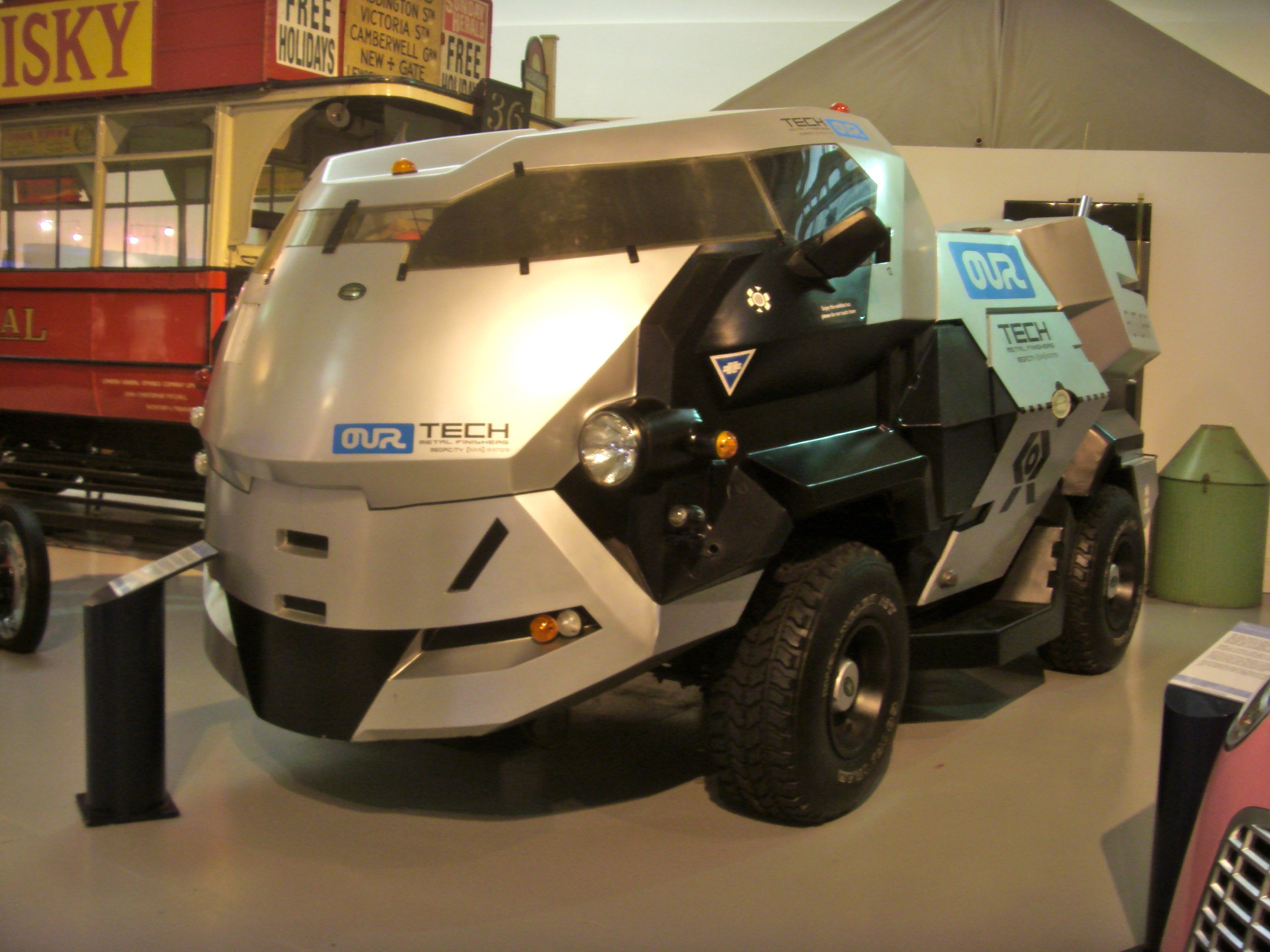
Disposal put an unusually large share of the type into private hands, and it has been well looked after. The 101 Forward Control Club and Register, formed in 1988 to keep the trucks running, still runs a parts operation from Totton; the REME Museum shows a 101 with a crane; the Dunsfold Collection holds chassis number one, the ambulance prototype and the Sahara car. Thirty-one 101s were rebodied by Land Rover for the 1995 film Judge Dredd as the City Cabs, one of which, the registry's Dredd City Cab, sits in the British Motor Museum at Gaydon next to a 101 prototype. The ambulance record and the Sahara car stand for the two ends of the story: the one-tonne truck that towed the gun for twenty years, and the four that crossed a desert before the production line had properly begun.

.jpg)
Registry records · chapter 4
On expedition
1 documented expedition driven in this marque · all expeditionsIn service
Where the registry's 101 Forward Control records worked; each opens the themed history.Manufacturers
Sources
- Land Rover 101 Forward Control — Wikipedia (1967 development under Norman Busby, 1972–78 production at Lode Lane, V8, 101-inch wheelbase, GS/ambulance/Vampire/Rapier variants, 12V/24V, fifty Australian Army vehicles, Judge Dredd cars, Nokken winch, withdrawal for Defenders and Pinzgauers)
- The 101 Forward Control — Ex-Military Land Rover Association (Light Gun origin from 1966, MVEE design committee, prototype dates, three-litre six, V8 from December 1968, year-by-year production table (2,660), Salisbury axle, Falklands, Gulf, Balkans, withdrawal 1998–99, refurbishment offer declined)
- 1972 101" Forward Control pre-production chassis No 1 — The Dunsfold Collection (96400001A, BXC 676K, square-nosed early design, six-cylinder before V8, powered trailer not beyond user trials, production from 1975)
- 1974 101" Forward Control Trans-Sahara Expedition vehicle — The Dunsfold Collection (95600024A, 'Tail End Charlie', delivered to RAF Uxbridge November 1974, Rubery Owen powered trailer, donated 2016 by David Olliver)
- 1975 Prototype 101" Forward Control Ambulance — The Dunsfold Collection (959000033A, RGN 239P, air-conditioning grille, Gurkha service, Gulf War)
- The Land Rover History: Forward Control 101 — Winwaed (1972 Commercial Motor Show, 4,000 lb towing requirement, LT95, Salisbury axles, 1-ton 109 brakes, detachable panels, service 1975 to late 1990s including ambulances in Kosovo, British and Australian armies)
- 101 1-ton Forward Control — guide2landrover (2,669 total including prototypes 1968–74, 300–450 ambulances, about 20 Vampires, about 125 radio trucks, Nokken winch on about 20 per cent)
- Land Rover 101 Forward Control — vehicle history — John Craddock Ltd (Development 1967, prototype 1969, reveal 1972, production 1975–78, Rubery Owen six-wheel-drive trains, RAF Regiment and Australian Army, 31 Judge Dredd cars, prototype at Gaydon)
- Two Sahara veterans reunite — Exploring Overland (Jonathan Hanson) (Four of the first production 101s, two with powered-axle trailers in this account, 7,500 miles, 81 days, HP-65 navigation, Sheppard reunited with a surviving car in 2012)
- Joint Services Expedition Sahara — Sahara Overland (Chris Scott) (Algeria refused entry, Geographical Journal report 1976, full report at Kew)
- Land Rover Llama — Wikipedia (1985 MoD requirement to replace the 101 fleet, RB44 chosen, Llama cancelled 1988)
- Land Rover 101 Forward Control (101FC) — Military Vehicle Trust showcase — NEC Classic Motor Show (Gun tractor and Rapier missile tractor roles)
- 101 Forward Control Club and Register — 101 Club (Club purpose and parts operation, Totton)
- Land Rover Military One-Tonne (James Taylor, Crowood) — The Crowood Press (Book scope — production 1975–78, service to 1998, overseas sales; page blocked (403), listing details taken from search results)
101 Forward Control records in the registry
10 records, oldest first.101 Forward Control Ambulance1972–78 · United Kingdom101 Forward Control Cargo1972–78 · United Kingdom 101FC Radio Body1972–78 · United KingdomSolihull Birdcage Winch Cable Truck1972 · United Kingdom
 Tail End Charlie — 101 Forward Control1974 · United KingdomJoint Services Sahara Expedition 101 FC1975 · United KingdomVampire EW1975–78 · United KingdomRapier 101FC1976–78 · United Kingdom
 Land Rover Llama1985–88 · United Kingdom
 Judge Dredd City Cab1994 · United Kingdom